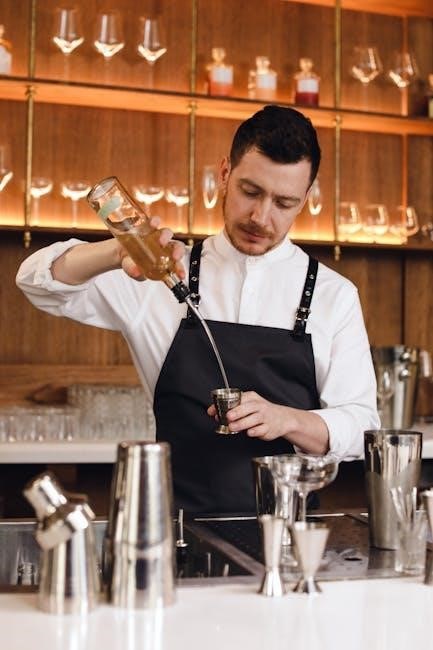
The PDT Cocktail Book, a comprehensive bartenders guide from a celebrated speakeasy, alongside Bar & Beverage Fundamentals,
offers essential knowledge for aspiring professionals.
What is a Bartender?
A bartender is a skilled professional dedicated to crafting and serving alcoholic and non-alcoholic beverages, demanding more than just pouring drinks. Resources like The PDT Cocktail Book and guides on Bar & Beverage Fundamentals highlight the depth of knowledge required. Bartenders expertly mix cocktails, manage bar inventory, and ensure responsible alcohol service.
They are often the face of an establishment, providing excellent customer service and creating a welcoming atmosphere. The role extends beyond drink preparation to include understanding flavor profiles, mastering mixing techniques, and staying current with industry trends – a true craft honed through study and practice.
The History of Bartending
The evolution of bartending spans centuries, with roots tracing back to ancient civilizations serving mixed drinks. While a definitive timeline is complex, resources like historical analyses referenced alongside modern guides such as The PDT Cocktail Book, demonstrate a progression. Early “mixers” evolved into skilled professionals.
The 19th and 20th centuries saw the rise of the cocktail culture, with iconic drinks and techniques developing. Publications documenting these advancements, alongside contemporary training like Bar & Beverage Fundamentals, preserve this legacy, shaping the modern bartender’s role.
Essential Bar Tools & Equipment
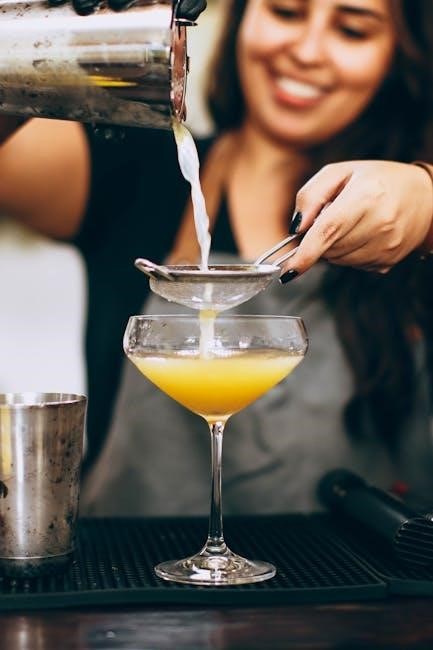
Bartenders guides, including resources like Bar & Beverage Fundamentals, emphasize mastering tools – jiggers, shakers, spoons, and strainers – for precise drink creation.
Jiggers & Measuring Tools
Jiggers are paramount, as highlighted in foundational bartenders guides like Bar & Beverage Fundamentals, ensuring consistent cocktail balance. Accurate measurement isn’t merely preference; it’s professional standard. These tools, available in various sizes (typically halves, thirds, and quarters of an ounce), guarantee recipe replication. Beyond standard jiggers, consider graduated cylinders for larger batches or precise dilutions. Mastering these tools, alongside understanding fluid ounces versus milliliters, is crucial for any aspiring mixologist. Precision directly impacts flavor profiles and customer satisfaction, solidifying a bartender’s skill.
Shakers: Boston, Cobbler, French
A solid bartenders guide, such as those referenced in industry resources, details three primary shaker types. The Boston shaker, favored by professionals, comprises a metal tin and glass. Cobbler shakers, with built-in strainers, are beginner-friendly. Lastly, the French shaker (Parisian) offers a sleek, two-piece metal design. Understanding each shaker’s strengths is vital. Boston shakers demand skill for a tight seal, while cobblers simplify straining. Proper technique, detailed in comprehensive manuals, prevents dilution and ensures a perfectly chilled, well-integrated cocktail.
Bar Spoons & Strainers
Any thorough bartenders guide emphasizes the importance of quality tools. Bar spoons, with their long handles, are crucial for layering and stirring cocktails effectively. Strainers are equally vital. Hawthorne strainers, with their spring, fit Boston shakers. Julep strainers, bowl-shaped, are ideal for stirred drinks. Fine-mesh strainers remove small ice shards for clarity. Mastering these tools, as detailed in professional resources, ensures smooth pours and refined presentations, elevating the overall cocktail experience for the discerning patron.
Glassware: Types and Uses
A comprehensive bartenders guide dedicates significant attention to glassware. Different cocktails demand specific vessels. Coupe glasses, elegant and stemmed, suit shaken drinks. Rocks glasses, short and wide, are for stirred cocktails served on the rocks. Martini glasses, iconic and conical, showcase clarity. Highball glasses accommodate tall, refreshing drinks. Proper glass selection isn’t merely aesthetic; it impacts aroma, temperature, and the overall drinking experience, as highlighted in detailed professional manuals and training resources.

Understanding Spirits
Bartenders guide books emphasize mastering spirit categories – whiskey, vodka, gin, rum, and tequila – understanding their production, varieties, and flavor profiles is crucial.
Whiskey: Bourbon, Scotch, Rye
Bartenders guide books dedicate significant sections to whiskey, dissecting its core types. Bourbon, originating in Kentucky, requires a majority corn mash and new oak barrels for aging, yielding sweet, vanilla notes. Scotch, hailing from Scotland, boasts diverse regional styles – Speyside’s fruitiness, Islay’s smokiness – influenced by peat and maturation.
Rye whiskey, utilizing at least 51% rye grain, delivers a spicier, drier profile. Mastering these distinctions—grain bills, distillation techniques, and aging processes—is vital. Understanding their origins and characteristics allows bartenders to confidently recommend pairings and craft balanced cocktails, elevating the guest experience.
Vodka: Production & Varieties
A comprehensive bartenders guide book will detail vodka’s production, traditionally from fermented grains or potatoes, though other sources like grapes are now common. Distillation and filtration are key, aiming for a neutral spirit. However, varieties abound! Polish vodkas often retain subtle grain character, while Swedish vodkas emphasize purity.
Flavor infusions – citrus, pepper, berry – are widespread. Understanding these nuances is crucial. Bartenders must know how different vodkas interact within cocktails, considering their texture and subtle flavor profiles to achieve balance and complement other ingredients effectively.
Gin: London Dry, Old Tom, New Western
A solid bartenders guide book explains gin’s diverse styles. London Dry is rigorously distilled, showcasing juniper and dry botanicals – a classic foundation. Old Tom, historically sweeter, offers a bridge between gin and genever, appealing to palates seeking a softer profile.
The New Western style embraces innovation, featuring less juniper and highlighting other botanicals like citrus, floral notes, or even unusual spices. Mastering these distinctions allows bartenders to select the ideal gin for each cocktail, enhancing complexity and delivering a tailored experience.
Rum: White, Gold, Dark, Spiced
Any comprehensive bartenders guide must detail rum’s spectrum. White rum, often used in lighter cocktails, is typically filtered post-aging. Gold rum gains color and flavor from brief aging, offering a richer profile. Dark rum, aged longer in charred oak, delivers molasses and caramel notes – ideal for sipping or robust drinks.
Finally, Spiced rum incorporates flavorings like vanilla, cinnamon, and clove, adding complexity. Understanding these variations empowers bartenders to choose the rum that best complements a cocktail’s intended flavor profile and overall balance.
Tequila & Mezcal: Agave Basics
A solid bartenders guide necessitates understanding tequila and mezcal’s agave origins. Both spirits derive from the agave plant, but differ in production. Tequila, primarily from Blue Weber agave, requires specific region designation. Mezcal embraces diverse agave varieties and traditionally employs earthen pit roasting, imparting a smoky flavor.
Bartenders should know classifications – Blanco (unaged), Reposado (briefly aged), Añejo (aged longer). Recognizing these nuances allows for informed spirit selection and crafting authentic, flavorful cocktails appealing to discerning palates.

Classic Cocktail Families
A comprehensive bartenders guide details foundational cocktail families like Sours, Old Fashioneds, Manhattans, and Martinis, showcasing variations and essential techniques.
Sours: Whiskey Sour, Daiquiri
Sours represent a cornerstone of classic cocktail creation, expertly detailed within a comprehensive bartenders guide. These drinks balance spirit, citrus, and a touch of sweetness. The Whiskey Sour, traditionally featuring bourbon or rye, showcases the spirit’s character. Conversely, the Daiquiri, a simpler yet elegant sour, highlights the purity of rum.
Mastering sours requires understanding balance; adjusting ratios to complement the base spirit is key. A quality guide will explore variations – from shaken to dry-shaken techniques – enhancing texture and flavor. Proper dilution and chilling are also crucial for a perfectly balanced sour.
Old Fashioned Variations
A thorough bartenders guide will dedicate significant attention to the Old Fashioned and its diverse iterations. While the classic formula—spirit, sugar, bitters, water—remains foundational, exploration is encouraged. Variations might include swapping bourbon for rye, utilizing different bitters (orange, chocolate, aromatic), or incorporating flavored syrups.
Modern twists often feature smoked spirits or unique garnishes, elevating the experience. Understanding the core principles allows for creative adaptation. A good guide emphasizes the importance of quality ingredients and precise execution, regardless of the chosen variation, ensuring a balanced and flavorful cocktail.
Manhattan & Its Relatives
Any comprehensive bartenders guide must cover the Manhattan and its extensive family of cocktails. Traditionally built with rye whiskey, sweet vermouth, and bitters, the Manhattan offers a rich, complex flavor profile.
Variations abound, including the Dry Manhattan (using dry vermouth), the Perfect Manhattan (equal parts sweet and dry vermouth), and the Rob Roy (using Scotch whisky). A skilled bartender, guided by a quality resource, understands the nuances of each spirit and vermouth, adjusting ratios to achieve balance and cater to individual preferences.
Martini Family: Dry, Dirty, Variations
A foundational element of any bartenders guide is mastering the Martini and its diverse iterations. The classic Dry Martini, typically gin or vodka with dry vermouth, demands precision in proportion and chilling. The Dirty Martini introduces olive brine, adding a savory complexity.
Beyond these, countless variations exist – from the 50/50 Martini (equal parts gin and vermouth) to those incorporating flavored vodkas or unique vermouths. A skilled bartender, informed by a reliable guide, understands the impact of each ingredient and adjusts accordingly, delivering a perfectly tailored Martini.
Mixing Techniques
A solid bartenders guide details crucial techniques: shaking for dilution and chilling, stirring for clarity, layering for visual appeal, and muddling for flavor extraction.
Shaking vs. Stirring
A comprehensive bartenders guide meticulously explains the difference between shaking and stirring, foundational mixing techniques. Shaking, utilizing a shaker with ice, rapidly chills and dilutes ingredients, creating a cloudy appearance – ideal for juice-based cocktails like Daiquiris.
Conversely, stirring, employing a bar spoon in a mixing glass, provides gentle chilling and minimal dilution, resulting in a clear, elegant drink, perfect for spirit-forward cocktails such as a Manhattan. The guide emphasizes that choosing the correct method significantly impacts the cocktail’s texture and overall balance, influencing the final drinking experience.
Layering & Floating
A detailed bartenders guide dedicates sections to advanced presentation techniques like layering and floating. Layering involves carefully pouring ingredients with differing densities over the back of a spoon, creating visually striking, distinct bands within the glass. This requires understanding specific gravity and precise pouring control.
Floating, a related technique, involves gently pouring a lighter ingredient over a heavier base, creating a visually appealing ‘cap’ on the drink. Mastering these skills, as highlighted in the guide, elevates cocktail presentation beyond simple mixing, showcasing artistry and attention to detail.
Muddling & Infusion
A comprehensive bartenders guide emphasizes the importance of flavor extraction through techniques like muddling and infusion. Muddling, gently crushing ingredients like fruits and herbs, releases essential oils and aromas, forming the foundation of many classic cocktails. The guide stresses avoiding over-muddling, which can lead to bitter flavors.
Infusion, a longer process, involves steeping spirits with ingredients to impart flavor. This technique, detailed within the guide, allows for creating unique and complex flavor profiles, expanding a bartender’s creative possibilities beyond standard recipes.

Garnishes & Presentation
A solid bartenders guide highlights that garnishes, like citrus twists and fruit skewers, elevate both the drink’s aroma and visual appeal, completing the experience.
Citrus Twists & Wheels
A comprehensive bartenders guide emphasizes the artistry of citrus garnishes. Mastering twists and wheels isn’t merely aesthetic; it releases essential oils, enhancing aroma and flavor profiles. Proper technique involves using a paring knife to carefully peel the citrus rind, avoiding the bitter pith.
Twists, elegantly draped over the glass, offer a refined presentation, while wheels provide a broader surface area for aroma diffusion. Different citrus fruits – lemon, lime, orange, grapefruit – impart unique characteristics. The guide stresses consistency in size and shape for a polished, professional look, elevating the overall cocktail experience.
Fruit Skewers & Wedges
A detailed bartenders guide highlights fruit skewers and wedges as vibrant garnishes, adding both visual appeal and complementary flavors. Skewers, featuring combinations like cherries, pineapple, and berries, offer a playful touch, while wedges provide a substantial, juicy element.
The guide emphasizes selecting ripe, high-quality fruit and ensuring it’s properly chilled. Presentation matters; skewers should be neatly arranged, and wedges should be carefully cut; Consider fruit pairings that harmonize with the cocktail’s ingredients. These garnishes aren’t just decorative; they contribute to the overall sensory experience, enhancing enjoyment.
Salt & Sugar Rims
A comprehensive bartenders guide details the art of applying salt and sugar rims, crucial for balancing flavors in specific cocktails. The guide stresses preparing the rim by lightly moistening the glass edge with citrus juice or water.
For salt rims, coarse salt is preferred, while superfine sugar works best for sweet rims. Even coating is key – rotate the glass gently in the rimming agent. This technique enhances drinks like Margaritas (salt) and Cosmopolitans (sugar), providing a delightful textural and taste contrast with each sip, elevating the overall cocktail experience.

Non-Alcoholic Options & Mocktails
A bartenders guide emphasizes creating flavorful mocktails, offering inclusive options alongside alcoholic beverages, ensuring enjoyment for all patrons and preferences.
Creating Flavorful Mocktails
Bartenders guides increasingly highlight the art of mocktail creation, moving beyond simple juice mixes. Mastering this skill requires understanding balance – sweet, sour, and bitter elements are crucial, just as in classic cocktails. Utilizing fresh ingredients, homemade syrups, and interesting infusions elevates non-alcoholic drinks.
Experimentation with herbs, spices, and unique fruit combinations is key. Consider texture; carbonation from sparkling water or club soda adds vibrancy. Presentation matters too – beautiful glassware and thoughtful garnishes enhance the experience. A skilled bartender treats mocktail creation with the same dedication as crafting a complex cocktail, ensuring a satisfying and flavorful beverage for every guest.
Popular Non-Alcoholic Drinks
Bartenders guides often feature a section on popular non-alcoholic options, recognizing the growing demand. Classics like Shirley Temples (ginger ale, grenadine, and a cherry) remain favorites. Sophisticated choices include sparkling cider, flavored sparkling waters, and expertly crafted lemonade variations.
Increasingly, bars are offering non-alcoholic versions of classic cocktails – a “Virgin Mojito” or “No-jito” is a common request. Utilizing shrubs (fruit-infused vinegar syrups) and homemade sodas allows for complex flavor profiles. Offering a diverse range demonstrates a commitment to inclusivity and provides appealing choices for all patrons.

Bar Management & Operations
Bartenders guides emphasize inventory control, responsible alcohol service, and maintaining strict bar hygiene – crucial for profitability and legal compliance.
Inventory Control & Ordering
Bartenders guides consistently highlight the critical importance of meticulous inventory control. Accurate tracking of stock levels – from spirits and liqueurs to mixers and garnishes – is paramount. This involves regular stocktaking, utilizing a par stock system to determine optimal quantities, and implementing a First-In, First-Out (FIFO) rotation method to minimize waste.
Efficient ordering procedures are also key. Analyzing sales data to predict demand, establishing relationships with reliable suppliers, and negotiating favorable pricing are all essential components. Proper documentation of all purchases and deliveries ensures accountability and helps prevent discrepancies. Ultimately, effective inventory management directly impacts profitability and reduces potential losses.
Responsible Alcohol Service
Bartenders guides universally emphasize responsible alcohol service as a core duty. This extends beyond simply checking identification to verify legal drinking age. It necessitates recognizing the signs of intoxication and intervening to prevent over-service. Training programs often cover refusal techniques and strategies for handling difficult situations with patrons.
Understanding local laws and regulations regarding alcohol sales is crucial. Bartenders must be prepared to politely but firmly refuse service to anyone visibly intoxicated or attempting to purchase alcohol for a minor. Prioritizing patron safety and adhering to legal requirements are fundamental aspects of professional bartending.
Bar Hygiene & Cleanliness
Bartenders guides consistently highlight bar hygiene & cleanliness as paramount for both customer health and maintaining a professional establishment. Regular sanitation of all surfaces – the bar top, counters, glassware, and equipment – is non-negotiable. Proper dishwashing procedures, including appropriate water temperatures and sanitizers, are essential to prevent the spread of germs.
Maintaining a clean workspace minimizes contamination risks and ensures a positive customer experience. This includes prompt spill cleanup, proper waste disposal, and adherence to local health codes. A consistently clean bar demonstrates professionalism and respect for patrons.

Advanced Bartending Techniques
Bartenders guides often explore flaring & bottle tricks, custom cocktail creation, and impressive ice carving—skills elevating bartending beyond basic drink preparation.
Flaring & Bottle Tricks
Advanced bartenders guides frequently dedicate sections to the captivating art of flaring and bottle tricks. These techniques, while visually stunning, demand rigorous practice and a firm grasp of bottle weight and momentum. Mastering these skills elevates a bartender from a drink maker to a performer, enhancing the guest experience.
However, safety is paramount; guides emphasize responsible execution to prevent spills or injuries. Beyond the spectacle, these tricks demonstrate dexterity and control, showcasing a bartender’s dedication to the craft. They represent a commitment to entertainment and a flair for showmanship, often found in upscale establishments.
Creating Custom Cocktails
Bartenders guides often progress to the exciting realm of custom cocktail creation. This involves understanding flavor profiles – sweet, sour, bitter, and strong – and how spirits interact. A skilled bartender doesn’t just follow recipes; they build them, adapting to guest preferences and available ingredients.
The process requires experimentation, a solid knowledge of classic techniques, and a willingness to embrace failure. Guides encourage documenting creations, noting ingredient ratios and tasting notes. Ultimately, crafting unique cocktails demonstrates a bartender’s artistry and elevates the bar experience beyond standard offerings.
Ice Carving & Presentation
While not always covered extensively in basic bartenders guides, advanced techniques like ice carving demonstrate a commitment to artistry. Presentation elevates the drinking experience, transforming a cocktail into a visual spectacle. Beyond simple cubes, clear ice is prized for its slow melt and aesthetic appeal.
More elaborate carvings – swans, logos, or abstract designs – require specialized tools and practice. However, even simple garnishes, thoughtfully placed, contribute to a polished presentation. A guide might touch upon the importance of chilled glassware and meticulous attention to detail, enhancing the overall impression.
Resources for Bartenders
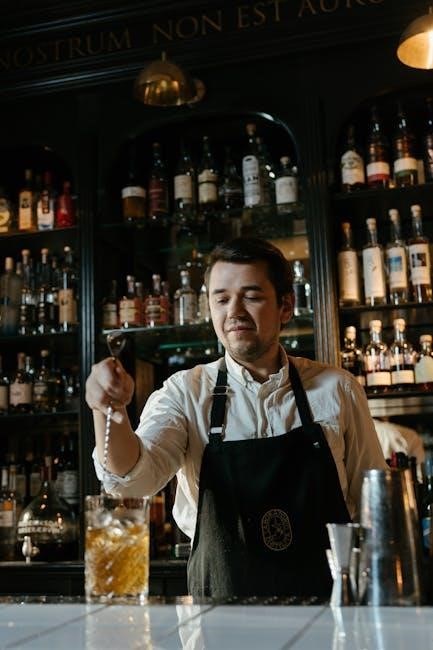
Bartending books, like The PDT Cocktail Book and Bar & Beverage Fundamentals, alongside online forums, provide continuous learning and professional development opportunities.
Bartending Books & Publications
The PDT Cocktail Book, published by Dram Good Books in February 2025, stands as a cornerstone resource, offering insights from a renowned speakeasy. Complementing this is Bar & Beverage Fundamentals, a guide to Bartending Qualification & NC II Assessment authored by Rafael M. Bachanicha, Ph.D.
These publications, alongside industry-specific journals and potentially historical timelines of bartending literature (spanning from 1605 to 2015 as referenced), provide a robust foundation for both novice and experienced bartenders. They cover techniques, recipes, and the evolving landscape of the profession, ensuring continuous learning and skill enhancement.
Online Communities & Forums
While the provided text doesn’t directly mention specific online communities, the recognition of bartenders through awards like “Bartender of the Year” (as highlighted by GreatList and T2’s collaborative project) suggests a vibrant professional network.
These awards and industry events likely foster online discussion. Platforms dedicated to cocktail creation, spirit knowledge (drawing from resources like The PDT Cocktail Book and Bar & Beverage Fundamentals), and bar management would be invaluable. Such forums allow for knowledge sharing, troubleshooting, and staying current with trends within the bartending world.